Keeping an eye on Nelson

This feature was included in the matchday programme for the Prescot Cables game against Padiham on August 11th, 2026. It leans heavily on the article in the Gone and Forgotten series from the old '@ballisround' website.
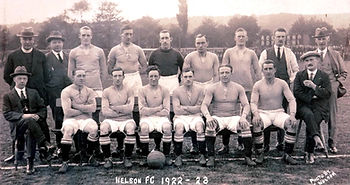
One hundred years ago, Northern Lancashire was a powerhouse of teams playing in the Football League. Clubs like Preston North End, Burnley, Blackburn Rovers and, even Accrington Stanley were well-known, successful and keen local rivals. But there were some pretenders within the region who have come and since disappeared. The names of Darwen and Blackburn Olympic are etched in footballing history but, today, we feature one club whose flame burned brightly for a short while, but flickered and died - Nelson FC.
Nelson is a small mill town nestling in East Lancashire, between Burnley and Colne. But for ten years the town could also boast a Football League side that also went on to beat one of the biggest football teams in the world.
In 1882, members of Nelson Cricket Club formed the new Nelson Football Club. The played in the Lancashire League, North-East Lancashire Combination, Lancashire Combination and Central League, before applying to join the Football League when it was expanded to accommodate the new regional third tier. They had the requisite facilities, with their Seedhill ground holding 15,000, but it was still surprising to many that their application was successful, especially as the previous season they had only managed a 17th place finish in the Central League,
They kicked off their new life as a league side in the Third Division North on 27 August 1921 in front of 9,000 spectators,. They took the lead in the 2nd minute of the game against Wigan Borough, when Billy Halligan scored, before falling to a 2-1 defeat. However, just a few weeks later they gained revenge on Borough with their first ever league win, coming away from Springfield Park with a 4-1 win, which saw them briefly top the league for the one and only time that season.
A 16th place finish in their first season was considered satisfactory, despite low attendances, but the following season, under the guidance of player-manager David Wilson, the club, remarkably, won the Third Division North title.
For the 1923/24 season in the Second Division, the squad was almost completely rebuilt with three figure sums - a lot of money at the time - paid to bring in talent such as Mike McCulloch from Hearts and former Manchester City star, Dick Crawshaw, from Halifax Town.
Prior to the start of the season they embarked on a pre-season tour of Spain that saw them play Racing Santander, Real Oviedo and, amazingly, Real Madrid. A double from Dick Crawshaw, along with goals from Joseph Eddleston and Bobby Hutchinson gave Nelson a 4-2 win in Madrid, which meant they became the first English side to beat them at home!
Nelson’s adventure in the second tier of English football lasted just a season as they finished in 21st place in 1923/24 and were relegated back to Division Three North. There were few high points during the season as they struggled with the step up in class, suffering some significant defeats, such as an opening day 6-2 hammering at Bradford Park Avenue, 5-1 at Hartlepools United and 5-0 against Walsall, although they did beat eventual champions, Leeds United, at home, and Manchester United at Old Trafford.
The following season they looked to bounce straight back, but a second place finish behind Darlington, proved to be the highpoint of their remaining time as a league club. With only one team promoted from the Third Division North, the club missed out on promotion and the subsequent seasons saw them slowly fade from prominence. In May 1928 they were forced to seek re-election for the first time, after finishing in last place, conceding 135 goals, and £6,500 in debt.
Fortunately, they retained their place at the expense of Durham City. But three years later, in 1931, they finished rock bottom of the division and were not so lucky in the re-election vote. After an initial tied vote with Chester, a recount was held and Nelson lost by one vote. Nelson’s last game in the Football League was a 4–0 defeat to Hull City on 2 May 1931.
The club joined the Lancashire Combination with the avowed intent to gain their place back in the Football League, but within three years, continuing financial pressures saw the Football League directors ordering that the club must permanently close. A new company was quickly formed to continue football operations, but on the eve of the 1936/37 season the club folded after "incurring a big financial loss".
A new amateur team, Nelson Town, kept the Seedhill spirit alive until World War II. After the war, the Nelson Football Club was reformed iand rejoined the Lancashire Combination. They entered their most successful period in the club’s history, under player manager Joe Fagan, being crowned champions in 1949/50 and finishing 2nd, 1st 5th and 3rd in successive seasons. Despite this success, they failed in an application for re-election to the Football League.
Nelson moved from Seedhill to Victoria Park, known locally as Little Wembley, in 1971, with the ground being demolished in 1980 to make way for the M65 motorway.
The club now competes in the North West Counties League Premier Division.

